Research shows that young people flourish best when they’re well supported in school, at home and at church. I wanted to find out how this research was evidenced in a setting where local school children were attending a church group. So… I visited the Fridge at Christchurch Clevedon, an after-school group for years 3-6 (age 7-11).
The Fridge is a ‘really cool place to hang out’ and sees around 20 children every week, many of whom have come through the church’s Transforming Lives for Good early intervention coaching hub.
I had 3 questions to ask the young people
What 3 words best describe you?
Where can you be most you?
What makes you feel safe in these spaces OR how could they improve to make you feel safer to be you?
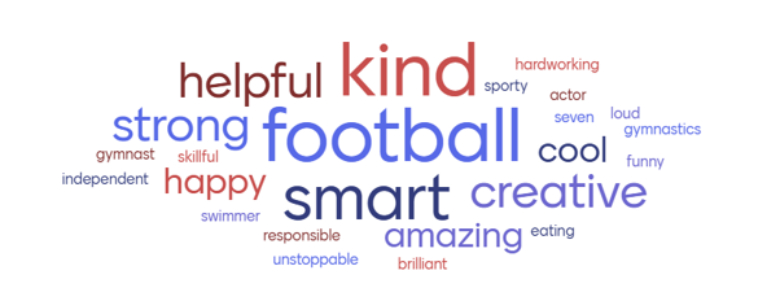
What three words best describe you?
This word cloud shows that the most frequently used describing word was ‘football’. These children – boys and girls alike – LOVE football. It’s fun to see that the things they’re passionate about are the words they use to describe themselves – gymnastics, swimming, acting… We really are shaped by the things we love and spend time on – even at such a young age.
Kind is another big word in the word cloud. Along with helpful, smart, creative and amazing.
I wonder how you would describe yourself? Would you use such bubbly and powerful words as ‘amazing’, ‘funny’ ‘skilful’… Would you choose the things your passionate about? What could we learn, or re-learn about ourselves, if we saw ourselves through the lens of a primary schooler?
I then presented the children with a Venn diagram and asked them to draw themselves on the diagram where they felt they could be most themselves.
You’ll see from my recreation that most of the children put themselves either in the ‘ALL’ section, or the ‘Home’ section. One put themself just in ‘School’ and none chose just ‘Church’. One child put himself outside of the diagram as he felt he couldn’t be truly himself in any of those spaces.
The best outcome would be to see all those children drawing themselves in the middle ‘All’ section. So that begs the questions:
What needs to change in order for young people to feel safer to be themselves in each of these spaces?
How to we nurture and create safe spaces for children?
What creates unsafe spaces and what do we do about that?
What about those who don’t feel safe or free to be themselves in any of those spaces? Why is that? What do we do?
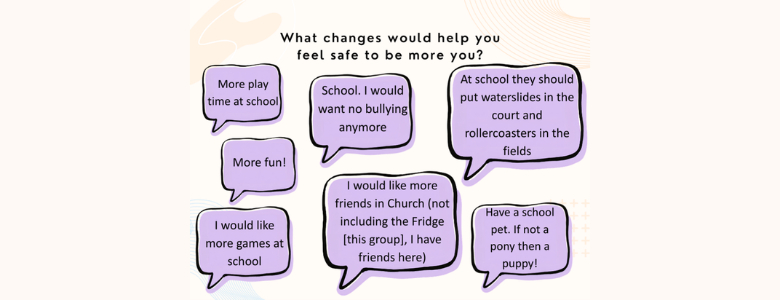
This led me to a couple more questions… what is it about these places that make you feel safe, and what needs to change to create or increase those feelings of safety? Here are some of their answers.
When the footballers had been released to play football (with much cheering and boundless energy), I had a slightly calmer(!) chat with two 9-year-old girls hear their thoughts.
What would make school a better place for you?
I wish I could have a pony there, if not a pony then a puppy. And make sure no one bullies you, that happens a lot. Teachers care more during learning than at play time.
We have a school council. They don’t always do a lot, but it would be good if they would get us more stuff for playtime.
What do you like about church?
No one is mean to you. It’s sometimes quiet – I like quiet.
I like tidy places and school isn’t tidy. In year 4 people would always leave things on the table and expect me to clear it up but in year 5 they don’t do that because we all have our own tables and people have fidget toys that they have chosen. Church isn’t messy like school.
I like that I feel listened to at church – there are less people and more adults. It’s like a whole class of children but 4 classes’ worth of adults!
For the reader, what can we notice from these answers?
Children want (need) fun. Fun creates feeling of safety and safety is where they thrive
Safety looks and feels different for different children, so spaces need to be diverse in what they offer (e.g. spaces to be loud or quiet, big enough for running around in, gentle for crafting, big enough for a school pony…!)
Children have an awareness of leadership authority and structures, (e.g. teachers, school council…) and can recognise when there is injustice or inefficiency
Children appreciate the presence of safe adults with availability for attention and investment
Do you notice anything else?
What do we take away from this?
I started this session by asking the children ‘who gets asked to listen to adults a lot?’ every hand in the room went straight up. Then I asked ‘who would like it if the adults would listen to what you have to say? to which there was a resounding ‘YES’!
Since we’ve asked them to speak, we must listen – and respond. Rather than prescribing the answer, I invite you to pause and wonder
What can you do?
How can you be involved?
What is God asking of you?
Perhaps you read and hear these comments and long for spaces in schools that feel safer and more fun for children. Maybe you hope for your church to be a safe place that opens up to children and young people as a safe harbour for friendships and memories to be made. Maybe you wish for every child to have an adult takes time to listen and understand them.
To provide the best experiences, we use technologies like cookies to store and/or access device information. Consenting to these technologies will allow us to process data such as browsing behavior or unique IDs on this site. Not consenting or withdrawing consent, may adversely affect certain features and functions.
Functional
Always active
The technical storage or access is strictly necessary for the legitimate purpose of enabling the use of a specific service explicitly requested by the subscriber or user, or for the sole purpose of carrying out the transmission of a communication over an electronic communications network.
Preferences
The technical storage or access is necessary for the legitimate purpose of storing preferences that are not requested by the subscriber or user.
Statistics
The technical storage or access that is used exclusively for statistical purposes.The technical storage or access that is used exclusively for anonymous statistical purposes. Without a subpoena, voluntary compliance on the part of your Internet Service Provider, or additional records from a third party, information stored or retrieved for this purpose alone cannot usually be used to identify you.
Marketing
The technical storage or access is required to create user profiles to send advertising, or to track the user on a website or across several websites for similar marketing purposes.



emily.jeffery@bathwells.anglican.org